
Does mouth taping work? Effects after a few nights of using lip tape
Does mouth taping work? Effects after a few nights of using lip tape
Have you heard about mouth taping, or sealing your mouth at night—and are you wondering if it actually works?
Mouth taping, or using lip tape for sleeping, is a very simple intervention: keeping your mouth closed during sleep to force nasal breathing—which is exactly what the body is designed for.
For many people, the problem is that they unconsciously switch to mouth breathing at night. It is estimated that over 40% of people breathe through their mouths during sleep, often without realizing it. This, in turn, affects sleep quality—from dry mouth and unstable breathing to more frequent awakenings.
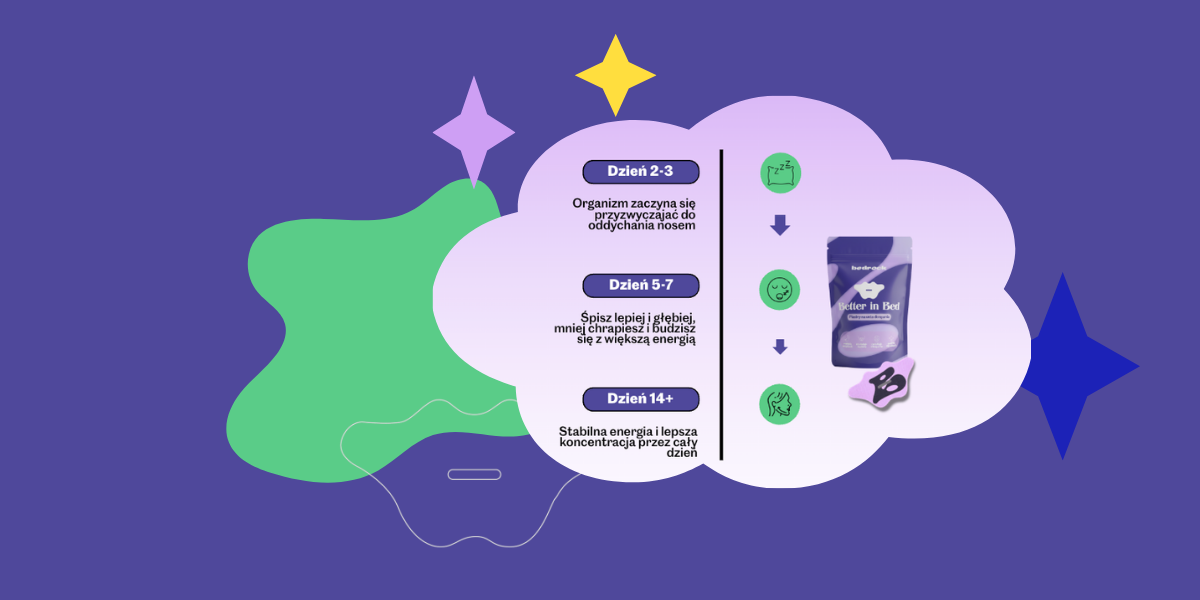
Therefore, the question isn't just "does mouth taping work," but rather: does changing the way you breathe at night affect the course of your sleep—and when do you see results? And this is precisely what becomes visible in the subsequent days of use.
Days 1–2: adaptation and the beginning of change (a process, not a one-time effect)
The first nights with the tape are usually a period of adaptation.
The body needs to get used to a different breathing pattern, so you might feel slight discomfort or a greater awareness of your breath. This is normal—a new stimulus appears.
At the same time, many people notice the first subtle change: less dry mouth in the morning or a calmer night. This is not yet the full effect, but a signal that something is beginning to change—and that this process requires a few more days to solidify.
Days 3–4: more stable sleep
After a few nights, the body starts to function more "automatically." Nasal breathing stops being an effort and becomes the default mode.
This is when more continuous, less interrupted sleep occurs. It's not a revolution overnight, but rather a noticeable change in sleep quality.
Well-chosen lip tape allows you to maintain this effect without discomfort.
Days 6–7: a noticeable difference
After about a week, the effects are usually most noticeable. Not because something magical is happening, but because the body has had time to adapt.
These are most often very specific changes: more energy in the morning, less feeling of being unrested, easier falling asleep, and fewer awakenings at night. For some people, snoring is also reduced, and sleep comfort is improved—without dry mouth.
This is the cumulative effect of small changes that together start to make a real difference.
Longer than a week: this is where the real change solidifies
After the first few days, the body not only gets used to the tape but begins to solidify the correct breathing pattern at night. Nasal breathing stops being forced and becomes a more natural, repeatable pattern.
And this is where the greatest value of regular use lies: sleep becomes more stable, falling asleep easier, and the risk of awakenings at night decreases. This is no longer the stage of "checking if it works," but the moment when the body begins to use nasal breathing more consistently—night after night.
If mouth taping is well-chosen and used regularly, in the long term it's not just about greater comfort, but about more predictable, calmer, and more restorative sleep.
How quickly does lip tape work?
The first changes can be felt after just 1–2 nights, but the fuller effect usually appears after several days of regular use. It's a process—the body needs time to stabilize the new breathing method during sleep.
Why does it work?
The key mechanism is simple: the way you breathe affects sleep stability.
Mouth breathing promotes irregular breathing and a higher number of micro-awakenings. Mouth taping works by eliminating this element—that is, switching to mouth breathing—and allowing a more stable breathing rhythm to be maintained at night.
Mouth taping does not "cure sleep." But for people who breathe through their mouths, it removes one of the significant factors that degrade sleep quality.
When are the effects not immediately visible?
Not everyone will see a difference after a few nights, and that's normal too.
Most often, this happens when the problem lies elsewhere—for example, with a blocked nose, stress, or very irregular sleep. In such cases, mouth taping is not a solution in itself, but one piece of a larger puzzle.
Is it worth trying?
If you breathe through your mouth at night, snore, wake up tired, or have a dry mouth in the morning, checking how you respond to nasal breathing at night is a reasonable step.
If you're just starting, see how to begin mouth taping. Not sure if it applies to you? Check if you are a mouth breather.
If you want to try it in practice, you can see how Bedrock mouth tapes for sleeping work—designed from breathable, comfortable materials and with a central opening that increases comfort and helps avoid a "closed" feeling.
Summary
Mouth taping works because it addresses a basic function—breathing during sleep—and for many people, it eliminates one of the key problems affecting sleep quality.
FAQ
Is mouth taping safe?
For most people, yes, provided nasal breathing is possible and there are no health contraindications.
How long do you need to use mouth tape?
The best effects come with regular use—it's a habit, not a one-time solution.
Can you breathe with mouth tape on?
Yes—breathing occurs through the nose. Well-designed tapes provide comfort and safety.




Comentarios